Adaptive Traffic Signals Explained: How AI and Sensors Reduce Wait Times
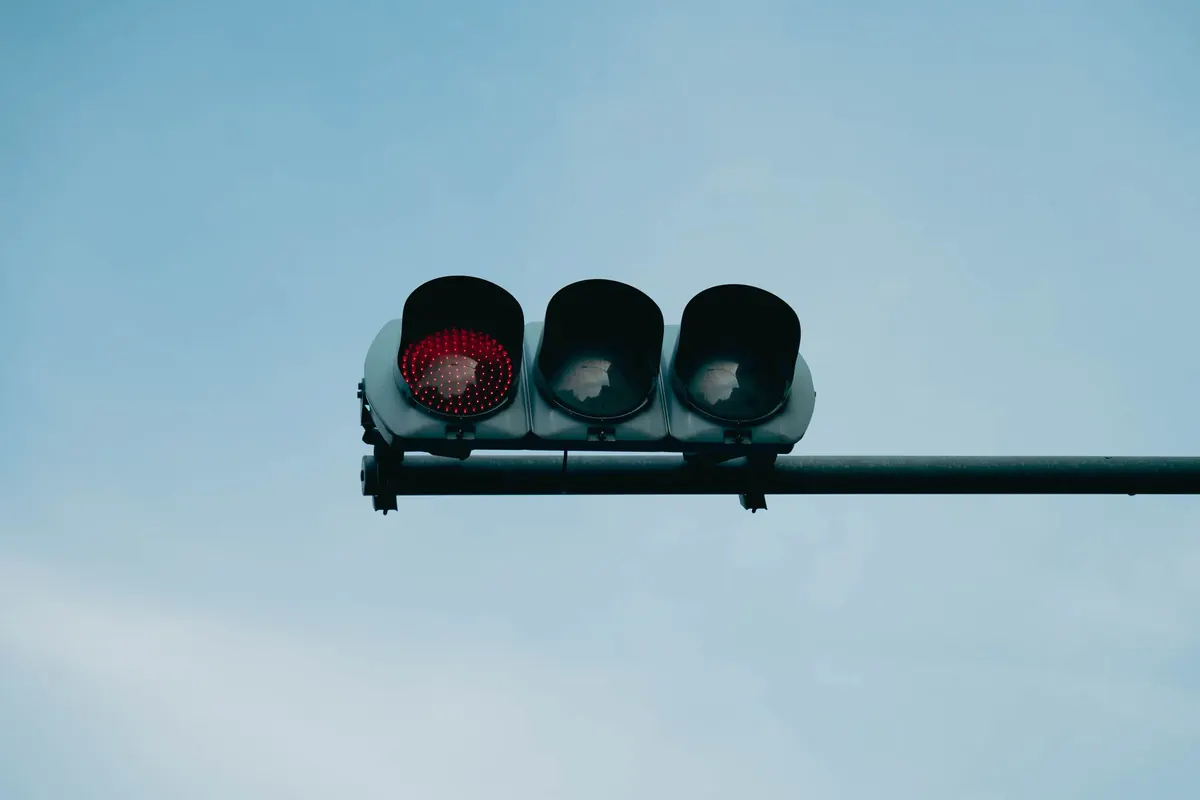
A driver idles at a red light on an empty road at 11:40 on a Tuesday night. Nothing is crossing. The light holds anyway, because the schedule says so. Multiply that scene across a city and you get a quiet tax on everyone's time: minutes lost at intersections timed for a rush hour that ended six hours ago.
Adaptive traffic signals exist to remove that tax. Instead of running a fixed plan, they watch what is actually on the road and adjust. The concept is simple. The details, and the question of who benefits, are where it gets interesting.
Most signals fall into three broad buckets, and a single corridor often mixes all three.
Fixed-time signals run a schedule. A plan for the morning peak, another for midday, another for overnight. The timing is based on turning-movement counts collected during a study, sometimes years ago.
Actuated signals react locally. A detector in the pavement asks for green, or extends a green that is already running because more cars keep arriving.
Adaptive systems go further. They coordinate a group of intersections and re-optimize timing every few minutes, sometimes every few seconds, using measured demand rather than last year's counts.
The practical difference is real. An actuated signal can serve a left-turn lane when a car shows up. An adaptive system can notice that a school dismissal is loading the northbound approach at three intersections, shift green time toward it, then hand that time back when the surge passes.
Sensors are the whole ballgame. A signal that guesses wrong is worse than one that follows a mediocre schedule, so cities invest heavily in detection and in keeping it calibrated.
Raw detections become estimates: queue length on each approach, how many vehicles will arrive on red, how much green time each movement needs, whether a bus is running behind schedule. Those estimates feed an optimization routine that proposes new timings, and a set of safety constraints decides what is actually allowed.
The loop runs continuously, usually in this order:
Steps four and five are where the interesting policy fights happen. Everything the optimizer does is bounded by rules that people wrote down. If those rules only count vehicles, the system will happily trade pedestrian waiting time for vehicle throughput, and it will do so flawlessly, all day, at every intersection.
Done well, adaptive control produces shorter queues on the busiest approaches, fewer stops along a corridor, and green time that follows demand through the day instead of snapping between preset plans. Transit signal priority, where a late bus gets a slightly longer green or an earlier one, tends to produce the most visible public benefit per dollar.
The catch is maintenance. Detection fails. A camera drifts out of alignment, a loop is destroyed by utility work, a controller is left in a manual mode after a crash investigation and never switched back. An adaptive system running on bad data can perform worse than a fixed plan, and the failure is invisible unless someone is watching. That is why performance dashboards, commonly built on automated traffic signal performance measures, have become a standard request from transportation agencies.
Pedestrians are the hardest users to detect and the easiest to overlook, because the default objective is vehicle delay.
Push buttons frequently do less than people assume. At many intersections a button only calls a walk signal during certain phases, or does nothing at all during coordination, which is why regular users stop trusting it. Bicycles are often invisible to loops unless the loop is tuned and marked. Standard video detection performs poorly on people in dark clothing at night, in rain, or on someone using a wheelchair at walking speed. And because adaptive systems reward efficiency, they tend to shorten crossing times toward the minimum, which is fine for a confident adult and punishing for a child, an older adult, or anyone pushing a stroller.
Some fixes are well understood: leading pedestrian intervals that give people a head start before turning traffic moves, longer minimum walk times, and detector placement that actually covers the bike lane and the curb ramp rather than the middle of the travel lane.
Adaptive systems are expensive to install and expensive to maintain, so they get deployed where the case is easiest to make. That usually means high-volume arterials, often in wealthier commercial districts. Meanwhile, a neighborhood street with heavy foot traffic, a school route, several bus stops and modest car volumes may score poorly on a congestion-based ranking, even though it delays far more people per hour.
Two changes shift that math. First, measure person delay rather than vehicle delay, so a bus with forty passengers and a crowd at a corner count as much as forty cars. Second, publish the data: signal timing records, detection status, and pedestrian wait times. What gets measured tends to get fixed.
You do not need to be a traffic engineer to influence how this technology lands in your neighborhood. You need specific requests.
Adaptive signals are a genuine improvement over running the same plan through an empty night. They are also only as fair as the goals written into them. The technology is not the hard part. Deciding who should wait, and for how long, is.
Photo: Chorn Travit / Pexels
Previous Post
How to Vote in a Participatory Budgeting Process in Your City
Next Post
The Smart City Privacy Checklist: Questions to Ask Before Your City Buys New Tech